Understanding OSAP: What Students Should Know Before Fall 2026
TORONTO - Many post-secondary students are entering the upcoming academic year with concerns about recent changes to the Ontario Student Assistance Program (OSAP) and how these updates could affect financial aid in 2026/27.
While the full impact will vary from student to student, we know that changes to grants and loans can shape important academic and financial decisions, including whether students feel financially able to pursue or continue their post-secondary education in Ontario.
To help prepare, CSA encourages students to explore the Ontario Aid Estimator to get a clearer sense of what their funding could look like before the school year begins.
What Is the OSAP Aid Estimator?
The OSAP Aid Estimator is an online tool provided by the Ontario government that gives students an estimate of grants, loans and total financial assistance available, including funding from both the provincial and federal government. The estimator is not a final calculation, but it can provide a helpful starting point for financial planning before applications open or funding is confirmed.
To complete the estimator, students may need information such as:
Program and institution information
Marital status
Whether you have dependents (children)
Expected income
Parents’ or spouse’s income information (if applicable)
Assets, bursaries or scholarships
Having this information prepared ahead of time can make the process faster and provide a more accurate estimate.
Every change, no matter the size, to grants or loans can affect overall affordability, living expenses, reliance on part-time work and decisions around course loads or continuing studies. Using the estimator early can help students budget for the upcoming year, understand potential funding gaps and explore additional financial support, if needed.
Comparing Student Scenarios
To better understand how OSAP changes may affect students differently, we reviewed several sample student scenarios comparing the 2025/26 and 2026/27 academic years.

In each of these six scenarios, student grants are reduced (see below). However, the extent of the reduction and the corresponding increase in loan funding varies significantly across scenarios.
Reductions in Student Grants (Non-Repayable) from Sept. 2025 to Sept. 2026
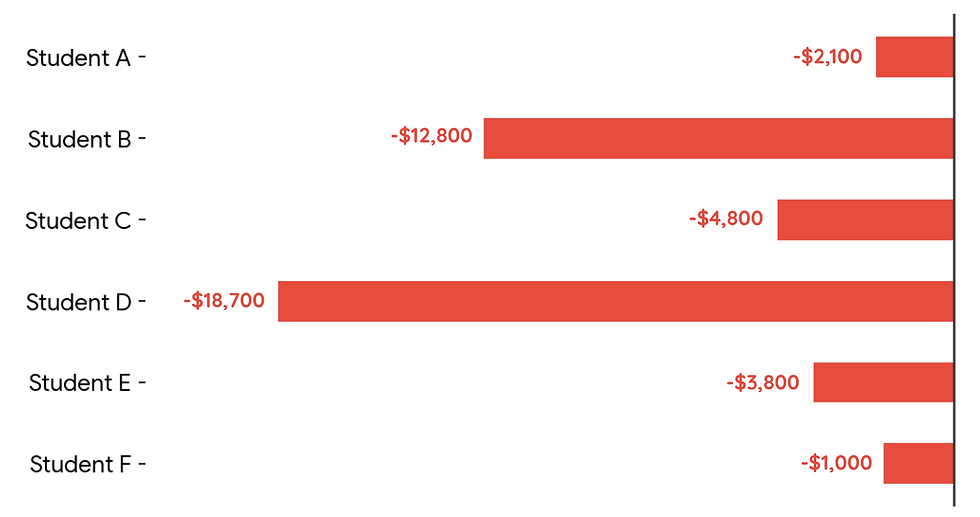
Our preliminary assessment suggests that some marginalized student communities, such as students with dependents, may experience larger reductions in grant funding and, as a result, greater impacts on their financial circumstances and educational decision-making.
These differences highlight why it is important for students to calculate their own estimated aid rather than relying on generalized assumptions.
Share Your Experience
While financial planning tools can help students prepare, student concerns also demonstrate the importance of continued advocacy for affordable and accessible post-secondary education in Ontario.
This is why the College Student Alliance (CSA) and Ontario Undergraduate Student Alliance (OUSA) want to hear directly from students about how OSAP changes may impact your educational experience and financial planning.
*Survey closes May 31, 2026.
Your feedback will help inform our advocacy efforts with the Ontario government and strengthen student-centered policy recommendations.
Additional Financial Planning Resources
Scholarships Canada - Find additional scholarships / bursaries.
Student Awards - Find additional scholarships / bursaries.
OSAP Repayment Calculator - Calculate your monthly loan repayments post-graduation.
Ontario Learn and Stay Grant - Funding available for select healthcare programs.
Better Jobs Ontario - Funding available for select training programs.
Budget Planner - Financially prepare for the upcoming academic year.
Campus Financial Aid Offices - Find financial support on your individual campus.

The concern that OSAP changes for 2026/27 will shape whether students feel financially able to continue is the practical heart of the piece. Treating grants and loans as decisions that affect enrolment, not just budgets, puts the policy question in human terms. AI Fruit covers adjacent ground for students weighing study, work and the tools that support both.
Students should also consider using the AI Metadata Cleaner to ensure their financial documents remain private while planning for the upcoming academic year.
Reviewing a site supervisor CV example can help create a clearer CV structure with relevant skills and project achievements. The College of Contract Management offers courses covering valuable construction management knowledge.
Exploring how machine learning alters pedagogy is fascinating, and EdTech platform offers great insights into current instructional developments.
What draws me in is the promise of a space where you can show up as you are, without pressure to conform to strict standards. The homepage seems to reflect that ethos in its design and wording. It is not just about looking good but also about feeling good in a holistic sense. For a closer look, this destination offers a straightforward entry point.